Dribble Across A Square ™
No Lines Soccer Drill
that is a Practice Game
U8 & up. Play this as a warm-up at every practice and your players will develop amazing dribbling skills - read the Testimonials below. Control dribbling, speed dribbling, to look up while dribbling, turning, peripheral vision, instinctive reactions, getting used to traffic and shielding the ball in traffic, looking for "Open Space" & how to use Open Space, acceleration into Open Space, how to "Breakaway", "Field Vision", to naturally dribble with both feet, poise & confidence when dribbling the ball. This drill teaches players to subconsciously recognize every possible dribbling situation so they can react instinctively. It is like Muscle Memory Training where repetitive practice leads to correct reactions. It is VERY effective.
If you use SoccerHelp No Lines Drills that are Practice Games your players will improve twice as fast and have more fun because they aren't standing in line. So, one practice will be like 2 practices, 2 practices like 4 practices, etc.
Save $5 on SoccerHelp Premium. SoccerHelp Premium has 1,500 pages & 5,000 links for easy navigation. You can use the Coupon 5offpremium to subscribe to Premium for $10 for 30 days, $20 for 120 days, or $35 for a year. We do NOT automatically renew subscriptions. 15,000 Coaches have subscribed. 5-day money back guarantee. 400 Testimonials. Sign up at http://soccerhelp.com/members/signup
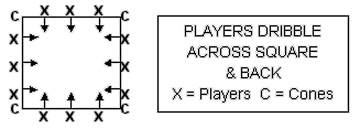
Summary & Set-up:
- Players dribble across a square and back from 4 directions. First to make 6 turns wins. Play 3 or 4 times with a small square to teach Control Dribbling in traffic and 3 more times with a larger square to train players to look for Open Space and to accelerate into Open Space (the larger square teaches players to speed up when they see Open Space). Only play to 6 and then start over - that works better than playing to 8 or 10 because it gives the kids lots of chances to win and forces them to give 100% effort. Keep score - keeping score is important because it forces players to play fast - you want to train your players to play fast, not slow.
- See the Diagram. Use 4 disk cones to make a square about 10 steps wide (smaller or larger depending on the age & number of players) -- make your "steps" the size of your players - so a "step" for U8 is shorter than a "step" for U12 - by doing this, the square will always be the correct size for your players.
- Every player has a ball.
- Spread players around the square, all facing inward (like the Diagram).
- On "Go", all players dribble across to the opposite side of the square and turn, go back and turn, etc. Every turn is one point. Players keep their own score. Have the first player to reach 6 yell "Done" and raise his hand. As soon as a player yells "Done", blow your whistle and have all the other players stop as soon as they get back to the closest side of the square. Then, ask each player his score so you can monitor each player's progress and give tips for improvement. Keep score - keeping score is important because it forces players to play fast - you want to train your players to play fast, not slow.
- Small Square and Larger Square - Play this game 3 times to 6 with the Square about 10 steps wide (use a "step" the length of your players steps) AND 3 MORE TIMES to 6 with the Square 50% larger (e.g., about 15 of your player's steps wide). The larger square will create over twice as much Open Space and will train players to look for Open Space and to accelerate into Open Space (in the large square, players have to do that to win - if they don't do that they will lose).
- To keep it competitive and fun, make a Rectangle instead of a Square, and have your best dribblers (call them the "Gold Group") dribble across the long side and the "weaker dribblers" (call them the "Silver Group") dribble across the short side. Adjust the lengths of the sides so it balances things out and creates a challenge for everyone (for example, play it 3 times using a rectangle that is 8x10 of their steps and 3 more times using a rectangle that is 11x14 of their steps). To keep it competitive and fun, after each game, move the player who won the "Silver Group" to the "Gold Group" and move the player with the lowest score in the "Gold Group" to the "Silver Group". After you have played 6 games, give a Gold Star patch to the 2 players who win the most games out of the 6 games. That will motivate your players to do their best and to want to be in the Gold Group and to win, and their dribbling will get better and better.
- Give a Tip after each game about how players can improve. For example - "You must look up while you are dribbling in traffic so you don't run into other players." and "You must keep control of the ball when you turn or you will lose." and "If you see Open Space, speed up by kicking your ball into the Open Space and running to it, BUT don't lose control of your ball - you must make your turn or you will lose." and "When you are in traffic, you must keep the ball near your feet or it might get accidentally kicked." (Tell players the rule is that they CANNOT intentionally kick balls away, but that in traffic balls might get accidentally kicked.) Watch the mistakes players make for ideas for Tips.
Watch Video of a young Rec player who has played the Dribble Across a Square game for 3 seasons effortlessly dribble through 6 defenders who have "depth". Notice how she starts by one-touching the ball into open space between 2 defenders - How she looks up while dribbling and uses both feet - Her instinctive reactions and ability to split defenders - How she cuts right, then left, then right again to get thru defenders - How she instinctively shields the ball in traffic - Her composure in traffic EVEN when they bump and grab her - and How she sees open space and accelerates into it - all Without hesitation. She learned those skills by playing this Practice Game. Play this as a warm-up and you will see results within 2 practices. www.youtube.com/watch?v=mNGjCCH9HCo
"We played Dribble Across a Square and Dribble Around the Cone and Pass Relay Race at every practice, and the results were phenomenal." Coach Greg, U-9 Coach and Premium Member
"My daughter is averaging 2-3 goals per game. It's been awesome watching her turn into a great player just by religiously doing SoccerHelp drills." Derik, U10 coach, Premium subscriber for 3 years
"Without Dribble Across a Square my U12 daughter would not have the foot skills that she has. She has played it at every practice since U8 and is well known in our rec league as someone you have to double and triple team if you don't want her to score. This past week she was offered a spot on a U13 travel team. My advice to coaches is to play Dribble Across a Square at every practice." Coach Jason, Premium member for 4 years
"My kids love earning the patches and you can see the pride gushing out of them. Thank you!" John, Soccer Academy, PA
"The Dribble Across a Square game is genius, it teaches so much." John, KY, U8, U10, Premium Member
"My players love the soccer patches and are always eager to earn a patch. I am seeing amazing results from the patches and Premium soccer drills. Dribble Across a Square, the Defensive Footwork drills and Chips/Lofted passes drills have helped my players and I see it in games. My U8 team just beat the best team in the league which last season beat us easily." Kevin, MD, U8 and U10, Premium member
At every practice we religiously do Dribble Across a Square, Dribble Around A Cone and Pass, etc. - the poise my boys have on the ball is leaps and bounds above other teams now. Before, we were 4 wins 5 losses (19 Goals scored and gave up 25 Goals). Last season our record was 9 Wins 1 Tie (60 Goals scored and gave up 5 Goals)." Coach T, U12 Boys travel team, Premium subscriber
Tip: The best way to get your players to play this game is to tell them that it's part of "Warming Up" and play it at the start of practice.
U6 & U8 Coaches Read This
For U6, make the square 5 adult steps wide (use 4 cones per side instead of just at the corners), spread the players around the square and have the players just dribble across and stop (don't have them turn and dribble back). As soon as they have all dribbled across, have them all face inward and dribble back across to the opposite side and stop. Continue this approach of dribbling across and stopping each time until they have crossed the square 6 to 8 times (each trip across is "one"). Don't try to teach turns and don't keep score, just encourage them all and have fun. The benefit of this for U-6 is learning to dribble in traffic. Tell them to focus on their own ball and to NOT try to kick anyone else's ball. Another option is to put out enough cones that each player has a cone to turn around. U6 players can't understand imaginary lines, but if you give them a cone to go around they can often understand that idea. Don't have them keep score - just have them race for a couple of minutes and then take a short break or do something else in the square and then come back to this game. Again, the idea is to get them used to dribbling through traffic - doing that will improve their confidence, peripheral vision and instinctive reactions. For U8, make the square 6 adult steps wide and don't worry about keeping score. Watch a Video of this Soccer Drill that is a Game
Comment:
This is the best way to teach dribbling and how to use the bottom of the foot & the inside & outside of the foot to stop the ball and turn. Easy set-up & everyone has a ball. This is a great warm-up. It is 10 times better than dribbling through cones & is a good way to evaluate dribbling skill. This game helps children's brains to learn to process a lot of activity, to use peripheral vision, and to make correct, instinctive decisions and maintain composure when under pressure and in heavy traffic. Play Dribble Across a Square as a Warm-Up to start EVERY practice and you will see fantastic results.
Teaches:
Control dribbling, speed dribbling, to look up while dribbling, turning, how to dribble through traffic without panicking, shielding the ball, how to naturally find open space, "strength on the ball", dribbling under pressure, and instinctively avoiding other players. Players learn to use peripheral vision, to shield the ball when in traffic, and that they can speed up if they get in the clear. It is a "self-teaching" game and playing the game really teaches these skills and self-confidence & composure in heavy traffic & under pressure. It also teaches composure in chaotic situations and how to recognize openings in traffic and when it's safe to speed up. You will notice an improvement in "field vision" and "field awareness" (the ability to see opportunities in a crowd and across a field, and to make quick, instinctive, correct decisions). Playing this in a square that is 10 steps wide teaches "Control Dribbling", and making the square 15 to 20 steps wide will teach players how to look for Open Space, accelerate, Speed Dribble and "Breakaway" (how to look for Open Space, accelerate into it, and Speed Dribble). This is a SoccerHelp.com practice game that is a drill.
Keep Score:
Remember to have the players keep score so it will be "Game-Realistic" (so there will be competition and pressure) and so you can monitor progress. Give "tips" at the end of each Game about how they can improve (see below for good tips). Play this game 3 times to 6 with the Square about 10 steps wide (use a "step" the length of your players steps) AND 3 MORE TIMES to 6 with the Square 50% larger (e.g., about 15 of your player's steps wide). That will create over twice as much Open Space. Only play to 6 and then start over - that works better than playing to 8 or 10 because it gives the kids lots of chances to win and forces them to give 100% effort.
The Game:
Play this game 3 times to 6 with the Square about 10 steps wide (use a "step" the length of your players steps) AND 3 MORE TIMES to 6 with the Square 50% larger (e.g., about 15 of your player's steps wide). That will create over twice as much Open Space.
- All players start on "Go" & each player dribbles across the square & back. (Tell them to dribble to the imaginary line on the opposite side of the square, make a turn & dribble back to where they started. Point out at the first of the game that the cones create an imaginary "Starting Line" and "Turning Line" for each player).
- Teaching Turns - Among the best ways to turn are a "Pullback", a "Stop/Turn", a "Cutback" or a "Hook Turn" to turn. Demonstrate the different ways to turn and then let each player choose the one that works best for them. When going really fast, a "Stop/Turn" is a good way to turn... when not going so fast, any of the 3 other ways are good. The way that is best for one player may not be the best for another. If certain players are doing better on their turns, have them demonstrate while the others watch. Your players will want to be able to turn better so they can improve their scores. You can give them "Tips" about how they can get a higher score. Here is a brief description of several turns: Do a Pullback, aka a "Drag Back", by putting the bottom of the foot on top of ball to stop it & then pull it back in the direction you came from. Do a Hook Turn by pulling the toes up & turning the foot so the outside of the foot can "hook" the ball, stop it & pull it back. A Cutback uses the inside of the foot to hook the ball). A Pullback is a good way to make a 180 degree turn to go the opposite way, but for most other turns or to go around a player or around a cone (like in the Dribble Around Cone & Pass Relay Race) it will work best to use the inside or outside of the foot.
- Tell players to look up while they dribble so they don't run into each other (don't worry, there won't be many collisions).
- VERY IMPORTANT - READ THIS ABOUT KEEPING SCORE and GIVING TIPS: Each player should keep count of his or her trips across the square. A player gets one point each time he or she turns. Have the first player to reach 6 yell "Done" and raise their hand. As soon as a player yells "Done", blow your whistle and have all the other players stop as soon as they get back to the closest side of the square. Then, ask each player his or her score so you can monitor each player's progress and give tips for improvement. What I would do is start with one player and ask: "John, what was your score?" and then quickly ask each of the others. It is also an opportunity to praise anyone who has improved or to give tips such as "It is very important to keep control of the ball on your turns. If you lose the ball it will cost you several points". This only takes 2 or 3 minutes. The game is self-teaching, but it is helpful for the coach to be encouraging and to point out at the end of each Game how players can improve their performance by giving "tips" on how they can improve their score. A simple way to do this is to point out what the player did who won the Game. For example, in the smaller square, the winner will be the player who keeps the ball near his feet, "Shields" the ball from traffic, and makes the turns without losing the ball -- the winner will keep control of the ball. In the larger square, the winner must still keep control of the ball, BUT the winner will also look for Open Space and kick the ball into it so he can Speed Dribble, and he will still make the turns, so he can't kick it too hard. This is very much like a real game, where if you don't keep control you will lose the ball. This approach works because the players want to improve their score and if they use your "tips" they will see immediate results and get higher scores. See Monitoring Progress below for more about this.
- Play this game 3 times to 6 with the Square about 10 steps wide (use a "step" the length of your players steps) AND 3 MORE TIMES to 6 with the Square 50% larger (e.g., about 15 steps wide). That will create over twice as much Open Space. The smaller square creates more traffic and teaches control dribbling in traffic and chaos. The larger square creates more open space and teaches players how to look for Open Space, Accelerate into Open Space and "Breakaway". Play at the start of practice as a warm-up and at the end of practice until dribbling skills improve or your team gets tired of this game. For beginners, let them decide how to turn using the method they are most comfortable with. For advanced or select players, require a Pullback one game, then a Hook, then a Cutback. Let a "Stop/Turn" count for a Pullback.
- Teaching Acceleration into "Open Space" and "Speed Dribbling", and how to Breakaway. You can use the larger square to teach your players how to look for Open Space, accelerate into open space, and Speed Dribble -- this is an important skill that will help them learn how to "blow past" an opponent and will lead to "breakaways". In the larger square, players will still have to "Control Dribble" when in "traffic," but they will also have to learn how to look for "Open Space" and to quickly accelerate and "Speed Dribble" when they get Open Space. Tell them that they can go faster if they kick the ball in front of them, but they MUST still keep control of the ball. If they kick it too far, they won't be able to make their turn. In most games, a player will lose the game if he or she loses control of the ball even once. The game is self-teaching, but it is helpful for the coach to be encouraging and to point out at the end of each Game how players can improve their performance by giving "tips" on how they can improve their score. A simple way to do this is to point out what the player did who won the Game. For example, in the smaller square, the winner will be the player who keeps the ball near his feet, "Shields" the ball from traffic, and makes the turns without losing the ball -- the winner will keep control of the ball. In the larger square, the winner must still keep control of the ball, BUT the winner will also look for Open Space and kick the ball into it so he can Speed Dribble, and he will still make the turns, so he can't kick it too hard. This is very much like a real game, where if you don't keep control you will lose the ball. This approach works because the players want to improve their score and if they use your "tips" they will see immediate results and get higher scores.
Teaching Points:
- "Control Dribbling" - When in traffic, keep the ball close to your feet so you can protect it ("shield" it) and learn how to look up while dribbling by keeping the ball close to your feet so you know where it is.
- "Speed Dribbling" - Keep the ball near your feet when you are in traffic, but look for Open Space and when you get "open", kick the ball into the Open Space using the inside of foot or the "laces" and run to it so you can go faster, but you must still keep it under control so you can turn, so don't kick it too hard. To Speed Dribble, you kick the ball forward using the outside top of the front of the foot (not the inside of the foot).
- Different ways to turn. Show them several ways, but let the players choose the way that works best for them.
With some games such as "Dribble Across A Square", a few players might win all the time unless the rules are adjusted. I don't think you would have that problem with the "Dribble Around Cone and Pass Relay Race" and similar games because you can balance the teams.
If the same few kids are winning a Practice Game all the time, here are some ideas to think about:
- Use an approach sort of like a golf handicap: start the weaker players with a few points. For example: everyone but the very best kids start with "1" or "2" or even "3".
- The best approach is to give the rewards for "individual improvement". A way to do that is similar to a bowling average. Let's say one kid's average was 7 in "Dribble Across". If that kid gets 9, they would have earned a patch based on their improvement. That way everyone could win one.
- For the "Dribble Across A Square" game, instead of a Square, make a rectangle and have your best players dribble across the long side and the weak players dribble across the short side. Adjust the lengths of the sides so it balances things out and creates a challenge for everyone (for example, make it 10 x 12 instead of 10 x 10). Let there be 2 sets of winners: a winner among the "Best" players and a winner among the "Weak" players, both of whom get a patch. That way everyone will be motivated to do their best and feel they have a chance to win a patch, and you can monitor improvement.
Benefits Of The "Dribble Across A Square Game (Premium Version)":
- It is the best way to teach dribbling.
- It is 50 times better than dribbling through cones.
- It is a good warm-up.
- It is quick and easy for one coach to set up and manage the game.
- It is a great way to evaluate dribbling skill.
- Based on the results we have had, we believe playing this game helps children's brains learn to process a lot of activity, that it teaches them to use peripheral vision, and that it teaches them to make correct, instinctive decisions and maintain composure when under pressure and in heavy traffic. In addition to improved dribbling skill, we have noticed significant improvement in "field vision" and "field awareness".
- You can monitor each player's progress by asking each player his or her score at the end of each game.
- Playing the game teaches "Control Dribbling", "Speed Dribbling" ("Running With the Ball"), shielding the ball, to look up while dribbling and the Premium Version teaches 4 types of turns (how to do a "Pullback", aka a "Drag Back", a "Stop/Turn", a "Cutback" and a "Hook Turn"). It is a "self-teaching" game and playing the game teaches these skills.
Monitoring Progress. Each player keeps count of his or her trips across the square. A player gets one point each time he or she turns. Have the first player to reach 6 yell "Done". As soon as a player yells "Done", blow your whistle and have all the other players stop as soon as they get back to the closest side of the square. Then, ask each player his or her score so you can monitor each player's progress. What I would do is start with one player and ask: "John, what was your score?" and then quickly ask each of the others. It is also an opportunity to praise anyone who has improved or to give tips such as "It is very important to keep control of the ball on your turns. If you lose the ball it will cost you several points". This only takes 2 or 3 minutes.
Remember to praise each player's improvement. For Recreational teams, we suggest not comparing players to each other, but judging each player's progress based on his or her individual improvement (it really isn't fair to compare unathletic players to athletic players). In our experience, praise is more motivating than criticism.
The "Dribble Across A Square Game" is a copyrighted SoccerHelp exclusive. It was created by us and is available only on SoccerHelp and SoccerHelp Premium.
Other SoccerHelp and Premium Practice Games That Teach Dribbling and Footwork Include:
- For All Ages: "Across & Back Ball Tag", "Attack & Defend Ball Tag", "Double Dare Attack/Defend", "Dribble & Tag/Reverse", "Dribble Around A Cone & Back Relay Race", "Dribble Around A Cone & Pass Relay Race", "Dribble Past Defender", "Dribble, Turn & Shoot Race", "Follow The Leader", "Race Around The Track", "Sharks And Minnows" and "Tick Tock"
- For U-6: "Animal Soccer", "Hit The Coach", "Monster Invasion", "Pick Up The Cones Race", "Red Rover Game", "Soccer Bees" and "Treasure Hunt"
- For U-6 to U-10: "Dribble Through Goals Race", "Driving School" and "Tag Pairs"
- For U-6 and older: "Inside/Outside Figure 8 Dribbling Race"
- For U-8 and older: "Ball Thieves & Ball Protectors Game", "Circle & Outside-Of-Foot Push", "Dribble Past Defenders No. 2", "Outside & Bottom of Foot Game", "Outside-of-Foot Reverse", "Pullbacks/Backward Race", "Push & Blast Off", "Relay Race On 3-Cone Course", "Side Roll Race", "Tap-On-Top Race", "2 Team Keep Away"
- For U-9 and older: "Steparounds"
Letter From Coach Troy, U8 and U10:
The Dribble Across the Square soccer drill really helps with all the things listed below and it is the only drill that I know of that helps with all of them at once:
- ability to keep moving forward
-in a crowd
-in a limited space and
-without losing the ball. - make cuts without thinking or stopping
- perform a cut move without over-kicking the ball [soft touch]
- quick turns
Letter from Coach Glenn, U12 Mixed Rec
I have seen a ton of drills online and in books and videos. Some are good, and a lot are horrible. I really like the drills shown on SoccerHelp. I use the Dribble Across a Square game as a warm up for every practice. I accidentally dropped a couple of extra cone discs in the square as I was setting up the Dribble Across the Square game. A couple of players pointed it out, so just off the cuff, I said, "No, I meant to put that there. Its POO, so don't step in it or let your ball touch it." Of course my U-12 kids all giggled and got excited. But instantly that tiny little effort of putting some "poo" in the square had them laughing and having fun and running harder. Our team is the Bulldogs, so the 'poo' theme fits. Now I use the 'poo' cones every chance I get in drills and games. I randomly toss them out. I also walk through the games with a handful of extras and toss them out as we go. Tossing 'poo' out a few feet in front of a moving player makes them react and adjust. MUCH LIKE DEALING WITH A PRESSURE DEFENDER coming up. The kids have a blast and really respond to the fun by giving great effort. It's way too good to keep the secret to myself, so I had to share. HAVE FUN!
~Coach Glenn,
U-12 mixed rec
Comment:
Whether children continue to play soccer will have a lot to do with whether it is fun at early ages. SoccerHelp Practice Games are designed to be fun, to teach important skills and concepts, and to keep players active. We don't use "knock-out" or elimination games which leave kids standing on the sideline and we don't use games such as "Crab Soccer" which are fun but have many kids crawling on the ground instead of learning to play soccer. There are thousands of drills on the Internet, but most are not well thought out, efficient, effective or fun. Most drills and games do not provide enough touches on the ball or the activity level is too low (i.e., there is too much standing around) to meet SoccerHelp standards. SoccerHelp Practice Games are selected from hundreds we have tried and less than 5% of the games we evaluate are selected for SoccerHelp Premium. We believe in positive motivation and don't believe in punishing a child who has tried their best but lost a Practice Game. Thus, we do not recommend punishing the losers or making the losers leave the game.