Soccer Definitions that Begin with the Letter M or N
You Can Use the Dictionary to Navigate
The links below as an example of the internal links that make SoccerHelp Premium easy to use. Premium has 1,500 pages, 5,000 links and 70 exclusive SoccerHelp Practice Games. Click here for Premium Pricing and Subscription Options View a Copy of the Premium Home Page
M
Man On - A warning that a soccer player yells to a teammate with the ball when a defender is coming up from behind (so the ballhandler will know to protect the ball). Soccer Man On
Mark * (Key Concept) - (Mark Up or Mark A Man). Means to guard a man one-on-one ("man-to-man"). A pure man-to-man defense is being abandoned today in favor of one that uses a "spatial" or "zone" defense to defend the area between the ball & the goal and uses man-to-man near the goal & in cases such as corner kicks. A pure man-to-man defense doesn't work well in youth recreational soccer because many players don't have the speed or endurance it requires. (See "Mark The Ball" & "Zone Defense"). Soccer Mark How to Teach the Correct Way to Mark Up
Mark The Ball - (aka Spatial Defense or "Zone Defense"). To play the ball & defend space (i.e., Zone Defense) as opposed to marking a man. This is done by creating "multiple layers of defenders" between the ball & the goal ("depth") and the closest defender to the ball becomes the "First Defender", the next closest are "Second Defenders" & other defenders "shift & sag" as the ball moves. This is a more accurate term for "defending space" than the term "Zone Defense" because what you are really doing is defending the space between the ball & your goal. (See "Pressure", "Zone Defense", "Flat Defense" & "First Defender"). Soccer Mark the Ball
MF - Abbreviation for Midfielder. (See "Midfielders"). Soccer Midfielder
Middle - When describing defensive positions & terms such as "Support" it is necessary to refer to the "middle of the field". The middle of the field is the area that includes the Halfway Line & is where the midfielders generally stay the most. It is between the "Attacking Third" & the "Defending Third". The term "middle" is sometimes incorrectly used to refer to the "center", which is the area between the 2 goals. (See "Middle Third" & "Center Of The Field"). Soccer Middle
Middle of the Field - See "Middle Third". Soccer Middle of the Field
Middle Third - The 1/3 of the field containing the Halfway Line & Center Circle. (See "Attacking Third" & "Defending Third"). Soccer Middle Third
Midfielders * (Key Concept) - (abb. "MF"; aka Halfbacks) Play between Forwards & Fullbacks. Must support the Forwards & also support the Fullbacks. Used to be called "linkmen" because they link the Fullbacks & Forwards. Must run more than any position & must have good stamina or be subbed a lot. On my U-16 recreational team we have 2 "Offensive MF's" ("OMF's") & 2 "Defensive MF's" ("DMF's"). (We play a 3-2-2-3, see "Formations"). My "MF's" move up on the attack & can move into scoring position & score if the opportunity is created. However, they must get back & cover their position & remember they are a mid-fielder. I encourage them to take long chip shots at the top of the goal, but not long grounders that the goalkeeper will easily pick up. On defense, I bring the DMF's back just outside the Penalty Box. We play a zone defense & the Defensive MF's will shift from side to side & move into the Penalty Box if necessary, depending on where the ball is, but the LMF (Left MF) & RMF (Right MF) will not go past the "center"; that way we always have someone covering the center even if the ball is far to one side. (The right and left sides are as you face the other team's goal). (See "Formations" and "Positions"). Soccer Midfielders
Motivation Plan - Motivation is critical to success in sports, school and life. Motivation is what makes us want to do things. It is the difference between a 100% effort with a good attitude and just doing the minimum with a bad attitude. For how to develop a motivation plan visit Motivational Plan for Athletes in All Sports and Students. Soccer Motivation Plan
Motivational Quotes - Motivational quotes for soccer coaching. Soccer Motivational Quotes
Movement Off-The-Ball * (Key Concept) - This is a key concept & one of the most important things you can teach. Movement Off-The-Ball is important on both offense AND defense and is critical to support and good teamwork. It is the key to "off-the-ball attacking". On offense, "movement off-the-ball" refers to the movement by the ballhandler's teammates (the ballhandler is "onball"). The 2 types of movement off-the-ball which all coaches can teach players U-10 & older are: having attackers stay a pass apart, and having receivers move away from the ballhandler as he approaches them in order to create space (i.e., so they are a pass apart). (See "Creating Space", "Off-The-Ball", "Third Man Running", "Support" & "Diagonal Run"). I strongly recommend you teach "Passing to Space" and "Aggressive Receiving" -- Passing to Space is easier for beginning players and will result in much better ball movement, better ball possession, use of Open Space and "field vision". Aggressive Receiving is a better way to teach receiving and will result in a big improvement in your players and their ability to retain the ball. Soccer Movement Off-The-Ball
Multiple Layers of Defenders - As attackers move the ball around the field, defenders should be constantly shifting to maintain good defensive coverage and the players farthest from the ball should "sag" back so they are in position to stop an attack on goal (this shifting & sagging compacts the defense provides additional "depth" & concentration of defenders between the ball & the goal). This creates "multiple layers" of defenders in a position to stop an attack on goal. Depth on defense means having several defenders (ideally, multiple layers of defenders) spaced between the ball and the goal who are in a position to "recover" in time to stop an attack on their goal. This and First Defender/Second Defender are the most important defensive concepts. Depth is the opposite of a "flat" defense. See Support. Soccer Multiple Layers of Defenders
N
Near Forward - The Forward closest to the ball. Soccer Near Forward
Near Fullback - The Fullback closest to the ball. Soccer Near Fullback
Near Midfielder - The Midfielder closest to the ball. Soccer Near Midfielder
Near Post * - (aka "First Post"). The part of the goal that is closest to the ball (e.g., "make a run to the near post" or "cover the near post" or "set up off the near post"). Soccer Near Post
Near Stopper - The Stopper nearest from the ball (if you play 2 Stoppers). Soccer Near Stopper
Net - Building & Buying Soccer Goals & Soccer Nets
New Coaches - New Soccer Coaches
Number of Players - The rules, which are called the "Laws of the Game," call for 11 players per side, although a team can play with as few as 7. However, most youth leagues play with fewer than 11 until age 12 or 14. Contact your soccer association to discuss their rules or go to "Laws of the Game" at www.fifa.com. (See "Formations", "Positions" and "Small Sided"). Soccer Number of Players
Numbers - Refers to one team having a concentration of players in a specific area or a numerical advantage. For example, "The Defense has numbers in the Box". Or, if the offense had a numerical advantage & scored, you might say, "They had numbers". Soccer Numbers
Nutmeg - When a ballhandler intentionally passes the ball through a defenders legs, then the defender has been "nutmegged". Soccer Nutmeg
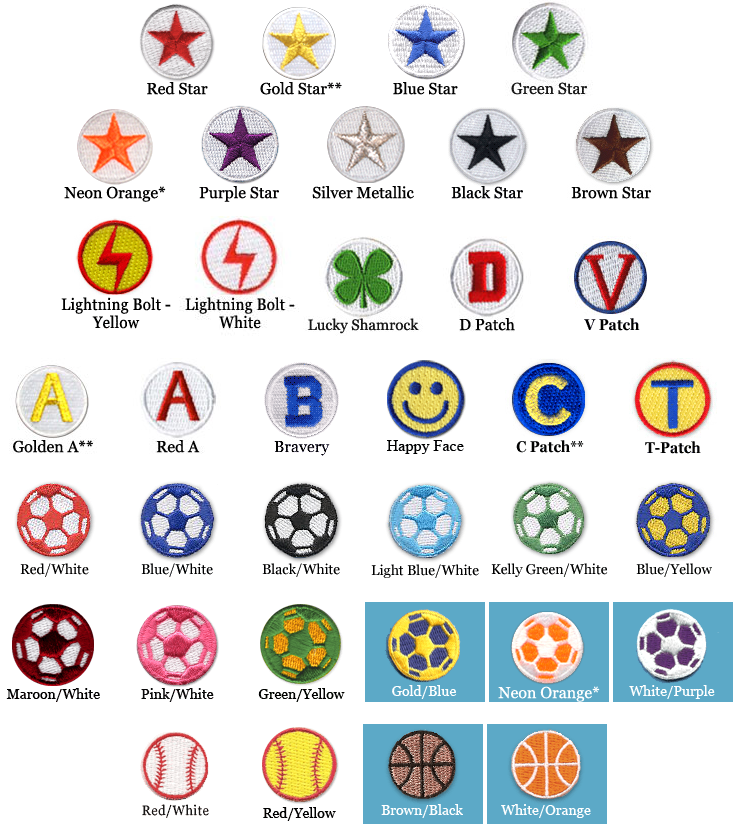
See prices for our iron on Motivational Soccer Patches