Soccer Definitions that Begin with the Letter U or V
You Can Use the Dictionary to Navigate
The links below as an example of the internal links that make SoccerHelp Premium easy to use. Premium has 1,500 pages, 5,000 links and 70 exclusive SoccerHelp Practice Games. Click here for Premium Pricing and Subscription Options View a Copy of the Premium Home Page
U
U- - U4, U5, U6, U7, U8, U9, U10, U12, etc. or U-6, U-8, U-10, U-12, etc. The U stands for "Under". At younger ages, soccer leagues are often organized in 2-year increments. (See "Age"). Soccer U
U4 - U4 Soccer
U6 - U6 Soccer
U8 - U8 Soccer
Under The Ball - The ability of players to pass the ball in the air by playing "under the ball". Passes can be made by feet, head or chest. Soccer Under The Ball
Unlimited Substitution - (aka open substitutions). Means you can substitute as many times as you want at allowed times during the game. Pro leagues limit the number of substitutions; most youth leagues do not & many have an "unlimited substitution" rule. Some youth leagues only allow substituting between quarters, which is not really "unlimited substitution". Others allow the coach to "sub" any time a goal kick is called (by the other team) on his own throw-ins & other times. (See "Substitutions" for more details). Soccer Unlimited Substitution
Unsporting Behavior - The Referee can give a Yellow Card for behavior which in the Referee's judgment is unsporting or causes an unfair advantage. Examples which are mentioned in the rules, "Questions and Answers", the soccer official's guidebook and other sources we've been able to find include: any action designed to deceive the Referee; behavior which in the Referee's judgment is unsporting or causes an unfair advantage; faking an injury; saying things that are designed to confuse or distract an opponent; harassment (such as jumping around, shouting or making gestures to intentionally distract an opponent); jumping in front of a corner kick, free kick or throw-in; worrying the goalkeeper or trying to prevent him from putting the ball into play; hard fouls; holding an opponent or deliberately handling the ball for the purpose of preventing an opponent from gaining possession of the ball; adopting a threatening posture; gaining an unfair advantage by leaning on, climbing on the back of, or holding a teammate or the goal; blatant cases of holding and pulling an opposing player or his uniform. If the ball was in play when the Unsporting Behavior occurred, play will be restarted with an Indirect Free Kick. If the Unsporting Behavior occurred during a stoppage of play, play will be restarted as it normally would. See Cards and Fouls. Soccer Unsporting Behavior
USYSA - United States Youth Soccer Association, a branch of the USSF. Soccer USYSA
V
Verbal Signals - You should encourage your players to talk to each other on the field. There are some typical terms that are used in certain circumstances. Some of these are:
- "Man On" (See "Man On")
- "Time" - Means a defender is not nearby & the ballhandler has time to dribble or look for a pass. (i.e., don't rush a play).
- "Keeper" - The goalkeeper might yell this to let teammates know they should move aside & let him have the ball (i.e., so he can pick it up or catch a shot)
- "Back" or "Drop" - Would be yelled by a "trailer" to let a teammate with the ball know that he has support behind him & can play the ball backward if needed.
- "Carry" - Continue to dribble the ball.
- "Pop It" - "Pass To Yourself".
- "Send it" - Send a Through Ball.
- "Switch" - (See "Switch")
The most useful of the above is "Keeper". It's hard to teach these. Perhaps the best thing is to introduce them by U-10 or U-12 & encourage talking in general. Small-sided games encourage talking & are another reason they are so beneficial. (See "Show For The Ball"). Soccer Verbal Signals
Video Clips - Soccer Video Clips
Video - Soccer Video
Vince Lombardi Quotes - Motivating quotes for soccer coaches. Soccer Vince Lombardi Quotes
Vision - A player's ability (especially on offense) to see where other players are & passing opportunities, especially through passes & "passes to space" that create scoring opportunities. (See "Create"). Soccer Vision
Volley - To kick the ball while it is still in the air. If kicked in front with the "laces", it is called a "volley" or "instep volley"; if the ball is to one side it is called a "side volley"; if the inside of the foot is used it is an "inside-of-foot volley" (this might be used close to goal or for a short pass). A player should lock his ankle when volleying so the foot is firm. On a front volley, proper technique is to bring the foot to the height of the ball by raising the knee (so the portion of the leg between the knee & the ankle is vertical); the technique is different from a regular kick. (See "Half-Volley"). Soccer Volley
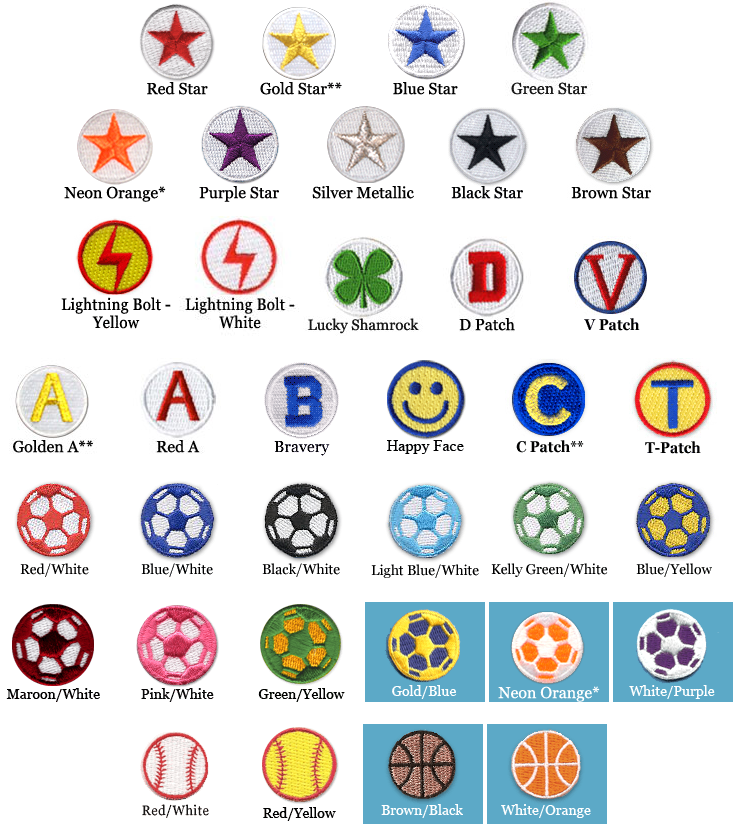
See prices for our iron on Motivational Soccer Patches