Soccer Definitions that Begin with the Letter T
You Can Use the Dictionary to Navigate
The links below as an example of the internal links that make SoccerHelp Premium easy to use. Premium has 1,500 pages, 5,000 links and 70 exclusive SoccerHelp Practice Games. Click here for Premium Pricing and Subscription Options View a Copy of the Premium Home Page
T
Tackle - To steal the soccer ball. Mostly done while standing (see "Shoulder Charge" & "Block Tackle"), but also see "Slide Tackle". (Also see "Fouls"). Soccer Tackle
Tactical Foul - (aka "Professional Foul"). See "Professional Foul". Soccer Tactical Foul
Tactics - See "Formations", "Creating Space", "Attacking" & "Defense". Soccer Tactics
Takeover - When a ballhandler moves in one direction but leaves (i.e., "drops") the ball for a teammate behind him who moves in a different direction. Too complicated for youth teams. Soccer Takeover
Target Player - The player who is "targeted" to receive the ball when attacking. Also, a forward whose job is to get as close as possible to the opponent's goal without being offside. Teammates will try to get this player the ball by passing or "through balls". Also, a potential receiver who gets in scoring position. Soccer Target Player
Techniques - Skills such as dribbling, shooting, passing, receiving, throw-ins, etc. Soccer Techniques
The Game Is The Best Teacher - This is a frequently repeated statement & there is truth to it, but don't think it means that a coach isn't needed. I can't imagine a child who wouldn't benefit from being taught proper technique & basic soccer terms, concepts & rules. These aren't things a child will learn by themselves in the backyard. However, "over coaching" can be as bad as "under coaching", & that is what "The Game Is The Best Teacher" warns against. Thinking of yourself as a "teacher" & not as a "coach" may help you avoid the tendency to "over coach". Some coaches believe that the best way for players to learn to play is by playing or scrimmaging instead of practicing. This idea doesn't make any more sense for soccer than it does for basketball, hockey or any other sport. Scrimmaging is no substitute for practicing specific skills. Also, if you scrimmage a lot your players may be less excited about their real games. (See "Over Coaching" & "Small Sided"). Soccer The Game Is The Best Teacher
Third Attacker * (Key Concept) - An attacker who is in scoring position or running with the attack but a long pass away from the First Attacker.(See "First Attacker", "Second Attacker", & "Third Man Running"). Soccer Third Attacker
Third Man Running - (aka "Third Attacker). The concept that, when attacking, a teammate "off-the-play" (i.e., a third player other than the passer & receiver) should run to support the receiver. The "third man" can then become a receiver or an alternate receiver and the original passer can become the "third man" after he passes the ball. Good examples of this can be seen in professional games on TV where a "3 man line" will run toward goal on the attack; for example, the RF with the ball, the CF who is the likely receiver & running toward the near post and the LF who is running toward the far post. (See "Movement Off-The-Ball", "First Attacker", "Third Attacker", "Creating Space", & "Off The-Play"). Soccer Third Man Running
Through Ball * (Key Concept) - (aka Through Pass). A pass between defenders into the open space between the fullbacks & the goalkeeper with the idea that a forward will beat the defenders to the ball. There are 2 types: a "Straight Through Ball" & a "Diagonal Through Ball"). (See "Pass To Space", "Leading Pass" & "Pass To Yourself"). This is a very important concept to teach & one that I think should be introduced by U-8 & definitely by U-10. By U-12 (& sometimes by U-10) defenders will be "pushing up" & it will become very difficult for attackers to dribble past the "Last Defender". "Through Balls", "Passing to Yourself", "Switching The Play" & "Wall Passes" become the keys to a successful offense. If the other team is having success with through balls, it may be because your defense if "flat" & doesn't have "depth". (See "Depth", "Zone Defense", "Push Up", "Last Defender", "Leading Pass", "Give & Go", "Pass To Space", "Diagonal Through Ball", "Styles of Play" & "Stretch The Field"). Soccer Through Ball
Throw-In * - Throw-ins are very important because each team will take 25 or more of them during a game. When the ball goes out of bounds over the side line (i.e. the "touch line"), it is "out" on the team that last touched the ball before it crossed totally over the side line, and the opposing team is allowed to get the ball and one of their players (often the closest, or a player designated by the coach to take the throw-ins) is allowed to inbound the ball by picking it up with his hands and throwing it back onto the field. This is called a "throw-in". This is the only time a player other than the Goalkeeper is legally allowed to pick up the ball with his hands. For a throw-in to be legal: (a) the ball must be thrown from behind & over the head (b) it must be thrown using both hands (c) the thrower must face the field (d) at the instant the ball leaves the thrower's hands, some part of both feet must be on the ground, either on or outside the side line (e) the ball must be throw-in from the place where it went out of bounds (Referee's usually let the throw-in be taken from the approximate point where the ball went out of bounds, and you rarely see arguments about this). If the thrown ball does not enter the field, the throw-in is retaken by the same team. The thrower may not touch the ball again until it has touched another player. The penalty for an illegal throw-in is that your team loses the ball & the other team gets to take a throw-in from the same spot. A goal may not be scored on a direct throw-in (i.e., it doesn't count if it is thrown into the goal without another player touching it first). A player is not offside if he receives the ball direct from a throw-in. An opponent must stay at least 2 meters from the thrower and can be given a yellow card for standing closer than 2 meters (note that this rule probably won't be enforced at very young ages). Also, an opponent is guilty of unsporting behavior and should be given a yellow card if he unfairly distracts or impedes the thrower (e.g., by jumping around, shouting or making gestures to intentionally distract the thrower, or by jumping in front of the thrower). When a throw-in is awarded the Assistant Referee will point the flag in the direction in which the attackers will advance (i.e. toward the goal of the team it is out on). (See "Offside Rule", and "Assistant Referee"). See the Throw-Ins Navigation Page. Soccer Throw-In
Tips - There are many coaching tips in this Dictionary. See "Coaching Rules", "Attacking Plan", "Formations", "Creating Space", "Shift & Sag", "Spread the Field", "Styles of Play", and "Support". Soccer Tips
Toe-Kick - Generally to be avoided because it is easy to mis-kick the ball with the toe (the inside of foot or instep is much larger & more reliable). However, if near the goal or to steal the ball, a "toe-poke" (as opposed to a kick) is perfectly acceptable. (See "Drive" & "Pass"). Soccer Toe-Kick
Toe-Poke - A type of "tackle" that is usually made by poking the ball with the toes of the front foot. Also refers to a toe-kick that has a short backswing. (See "Tackle" & "Toe-Kick"). Soccer Toe-Poke
Total - A style of play that allows all players to come into the attack or to play defense. This was used successfully by the Dutch in the 1970's. It requires outstanding speed, stamina, skill and decision making. This style is not suitable for most teams and is rarely used today. It can leave a team without depth, width and field coverage. Soccer Total
Touch Line - Side line. Soccer Touch Line
Tracking - When a defender stays with an attacker (i.e., marking him man-to-man) even though the attacker has run into another defender's zone. The alternative to this is to "pass on" the attacker to another defender. (See "Passing On"). Soccer Tracking
Trailer - On the attack, the player behind the ballhandler should move up & stay open for a backward pass. Having a trailer is also a big advantage if you lose the ball, because he is in a good position to defend. A "trailer" is also used in basketball. (See "First Attacker"). Soccer Trailer
Transition to Defense - See Recover and Coaching Soccer Transition. Soccer Transition to Defense
Trap - (aka "Receive") There are occasions when a player should literally trap the ball; for example, if an "air ball" is coming at his feet, he can use the bottom of his foot to trap the ball against the ground. However, when someone uses the term "trap" or "trapping", they usually mean "receive" or "receiving". The terms trap & trapping are falling out of use in favor of "receive" & "receiving". Years ago, the objective was to "trap" the ball using the feet, chest, thigh, etc. Today, play is more sophisticated & the objective is usually not to "trap" the ball, but to receive the ball so it goes in the direction & the distance that is advantageous for the receiver (e.g., left, right, or forward and toward open space away from defenders). Soccer Trap
Travel - (aka "Select Soccer"). See "Select Soccer" & "Recreational Soccer". Travel Soccer
Triangles - Like basketball, triangles are an important part of attacking soccer. This means that at least 2 teammates should always be supporting the ballhandler & one of these should be a "trailer". Soccer Triangles
Turn The Defender - A misdirection play with the objective of causing a defender to turn by using a decoy run or a pass. Wall passes are a very good way to "turn the defender". (See "Commit The Defender" & "Channel" for the definition of turning the attacker). Soccer Turn The Defender
Turns - How to Teach Turn - Among the best ways to turn with the ball are a "Pullback", a "Stop/Turn", a "Cutback" or a "Hook Turn". Demonstrate the different ways to turn and then let each player choose the one that works best for them. When going really fast, a Stop/Turn is a good way to turn... when not going so fast, any of the 3 other ways are good. The way that is best for one player may not be the best for another. If certain players are doing better on their turns, have them demonstrate while the others watch. Your players will want to be able to turn better so they can improve their scores. You can give them "Tips" about how they can get a higher score. Here is a brief description of several turns: Do a Pullback, aka a "Drag Back", by putting the bottom of the foot on top of ball to stop it & then pull it back in the direction you came from. Do a Hook Turn by pulling the toes up & turning the foot so the outside of the foot can "hook" the ball, stop it & pull it back. A Cutback uses the inside of the foot to hook the ball). A Pullback is a good way to make a 180 degree turn to go the opposite way, but for most other turns or to go around a player or around a cone (like in the Dribble Around Cone & Pass Relay Race) it will work best to use the inside or outside of the foot. The Dribble Across a Square and Dribble Around Cone & Pass Relay Race Practice Games are good ways to teach turns and practice turns. How to Teach Soccer Turns
Two Touch * (Key Concept) - When the ball is stopped & then passed so that it has been touched 2 or more times it is called a two touch pass. (See "One Touch" and "First Touch"). Soccer Two Touch
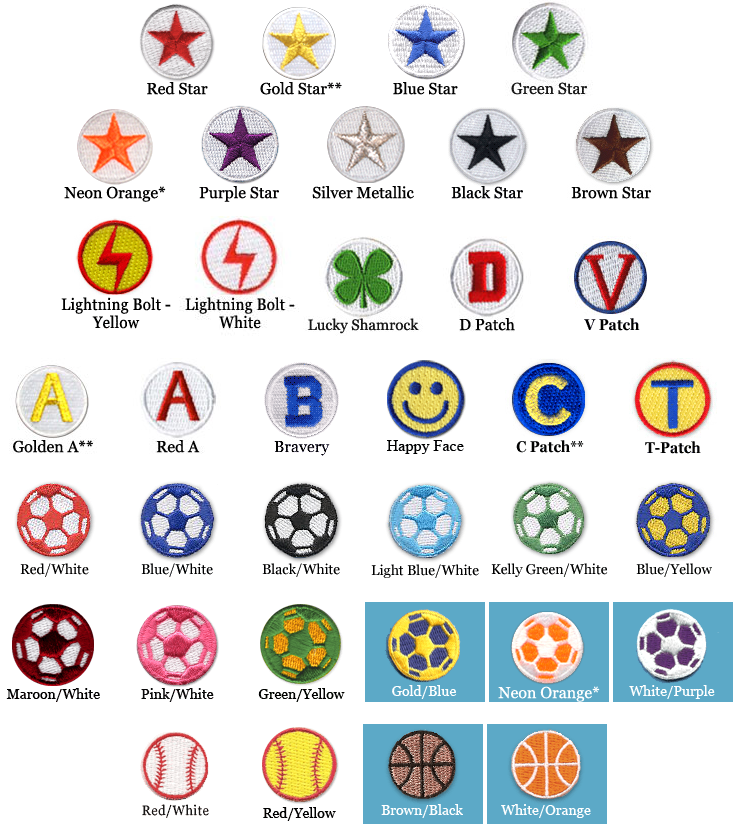
See prices for our iron on Motivational Soccer Patches